



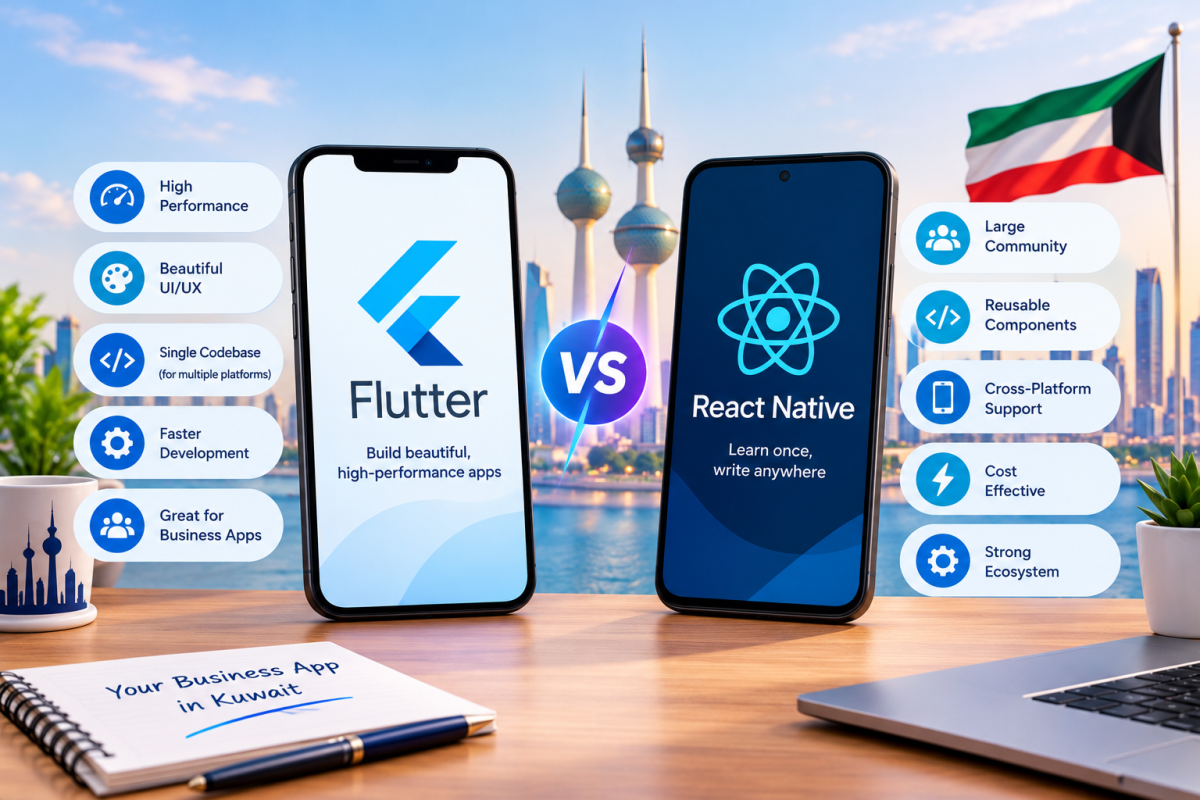
Choosing between Flutter and React Native is an important technical and financial decision for businesses planning a mobile app development in Kuwait.
The framework selected can influence initial development costs, feature implementation, maintenance requirements, and the effort involved in scaling the application as business needs change. Making the wrong choice can introduce unnecessary development work or limit future flexibility.
Both frameworks support cross platform app development, but their underlying technologies, customisation capabilities, and development requirements differ. Businesses need to evaluate these factors against their application requirements, existing technology infrastructure, and long-term growth plans before committing to either option.
At CliqTechno, a mobile app development company in Kuwait help businesses evaluate these technical considerations as part of services.
This guide compares Flutter and React Native across key development factors to help decision makers identify the framework that offers the right balance of performance, development investment, and long-term business value.
Understanding Flutter and React Native
Flutter and React Native are two established frameworks for cross platform app development. Both allow businesses to build applications for iOS and Android using a shared codebase, but their development approaches influence how applications are designed, customised, and maintained.
Flutter
Developed by Google, Flutter is an open-source UI toolkit that uses the Dart programming language. It provides its own rendering engine and widget library, allowing developers to create consistent interfaces across different platforms.
For businesses, this approach offers greater control over visual customisation, animations, and complex interface elements. It can be particularly useful when an application requires a distinctive design or consistent user experience across Android and iOS.
React Native
Backed by Meta, React Native uses JavaScript or TypeScript with the React programming model to develop mobile applications. It relies on native platform components, helping applications maintain interfaces and interactions that align with familiar iOS and Android experiences.
Businesses with existing JavaScript or React infrastructure may find React Native easier to adopt because their teams can draw on familiar development skills. It also supports native integrations when applications require platform-specific functionality.
Flutter vs React Native: Key Differences
Although Flutter and React Native both support cross platform app development, they take different approaches to building and running mobile applications. These differences can affect development flexibility, user experience, team requirements, and long-term maintenance.
Here is how the two frameworks compare across key areas:
| Comparison factor | Flutter | React Native |
|---|---|---|
| Programming language | Uses Dart, developed by Google. | Uses JavaScript or TypeScript with React. |
| UI design | Uses its own widgets and rendering engine, allowing consistent designs across platforms. | Uses native platform components, helping apps follow familiar iOS and Android design patterns. |
| Performance | Compiles Dart into native machine code and offers smooth rendering, particularly for custom animations. | Uses the Hermes JavaScript engine and modern native integration architecture to deliver near-native performance. |
| Development flexibility | Offers extensive control over layouts, animations, and custom interfaces. | Benefits from React’s component-based approach and a large JavaScript ecosystem. |
| Integrations | Supports native features through plugins and platform channels. | Supports native features through native modules, Expo, and community libraries. |
| Maintenance | Requires Dart and Flutter expertise, along with SDK and plugin updates. | Benefits from the wider JavaScript developer pool, though dependencies and framework upgrades need attention. |
What Do These Differences Mean for Your Business?
The choice becomes clearer when you consider your existing team and product requirements.
- Choose Flutter when your app needs a distinctive interface, consistent appearance across devices, or complex animations.
- Choose React Native when your business already has React or JavaScript developers, needs to reuse web development skills, or prefer platform-native interface components.
Performance alone should not decide the framework. Both can handle most business applications effectively, including booking platforms, eCommerce apps, and customer portals. The final experience depends heavily on app architecture, code quality, integrations, and testing.
Development Cost: Flutter vs React Native
Flutter and React Native have similar development costs for applications with comparable features and complexity. The final estimate depends on the development team’s location, experience, project scope, and technical requirements.
For a general comparison, the following are indicative international project estimates:
| App complexity | Flutter | React Native |
|---|---|---|
| Basic app / MVP | KWD 2,500–10,800 | KWD 2,500–9,900 |
| Mid-level app | KWD 6,200–23,200 | KWD 7,700–21,600 |
| Complex app | KWD 15,400–46,300+ | KWD 20,100–43,300+ |
These figures are broad industry estimates, not fixed prices for Kuwait. Businesses should request a project-specific quote based on their required features, integrations, and development scope.
Factors Affecting App Development Cost
The development budget involves two main considerations: the estimated cost of building an app with each framework and the factors that influence the final investment.
The following sections explain these factors to help businesses in Kuwait plan their mobile app development budget more effectively.
- App complexity: Basic applications with login and standard features require less development than platforms with real-time tracking, multiple user roles, or advanced functionality.
- UI/UX design: Custom interfaces, animations, and bilingual Arabic-English layouts can increase design and development effort.
- Third-party integrations: Payment gateways, maps, CRM systems, APIs, and push notifications add implementation and testing requirements.
- Backend development: User management, databases, cloud infrastructure, and admin dashboards contribute to the overall cost.
- Maintenance and updates: Bug fixes, security improvements, OS compatibility, and new features create ongoing expenses.
Need a Project-Specific App Estimate?
Talk to CliqTechno about your features, integrations and budget — no obligation, just clear guidance.
Which Framework Is Better for Different Business Applications?
The right framework depends on what your business app needs to do. An eCommerce store may prioritise smooth product browsing, while a fintech or on-demand application may require complex integrations, real-time updates, and reliable performance.
Here’s how Flutter and React Native compare across common business applications.
1. eCommerce Applications
Both frameworks support product catalogues, shopping carts, payment gateways, and order tracking. However, their development approaches offer different advantages:
- Flutter: Suitable for businesses seeking customised shopping interfaces, interactive product displays, and consistent designs across iOS and Android.
- React Native: A practical choice for businesses with existing React expertise or web-based eCommerce systems they want to connect with their mobile app.
2. Fintech and Banking Applications
Fintech apps require secure authentication, reliable transactions, and integration with financial services. Both frameworks can support these requirements when implemented with appropriate security controls.
- Flutter: Offers greater control over interface design, making it useful for building consistent dashboards, transaction screens, and customised user journeys.
- React Native: Can suit businesses with existing JavaScript teams and financial systems that require integration through APIs and native modules.
3. On-Demand and Delivery Applications
Food delivery, ride-hailing, and home service apps rely on maps, GPS tracking, push notifications, and real-time updates.
- Flutter: Provides flexibility for building customized tracking screens, interactive maps, and consistent interfaces across platforms.
- React Native: Offers access to native device features and JavaScript libraries, making it suitable for teams building location-based applications.
4. Booking and Service Applications
Appointment scheduling, hotel reservations, and service marketplaces need intuitive navigation, calendar features, notifications, and smooth booking processes.
- Flutter: Works well for applications requiring distinctive layouts, custom booking interfaces, and consistent visual experiences.
- React Native: Can be a good fit when businesses want to reuse React development expertise and connect mobile applications with existing web services.
Ultimately, both frameworks can support these business applications. The better choice depends on the required functionality, integrations, development expertise, and long-term product goals.
What Should Kuwaiti Businesses Consider Before Choosing?
Choosing between Flutter and React Native involves more than comparing development features. Businesses choosing a mobile app development company in Kuwait should also consider local customer expectations, payment preferences, technical requirements, and future expansion.
1. Arabic Language and RTL Support
- Flutter: Supports right-to-left layouts and Arabic text, allowing developers to customise bilingual app interfaces.
- React Native: Supports Arabic and RTL layouts through its internationalisation and layout capabilities, with additional testing needed for consistent presentation.
2. Local Payment Gateway Integration
- Flutter: Can connect with payment providers such as KNET through supported SDKs, plugins, or native integrations.
- React Native: Offers payment integration through JavaScript libraries, provider SDKs, and native modules.
3. Performance and Scalability
- Flutter: Its compiled code and rendering approach can support visually rich applications and consistent performance across platforms.
- React Native: Its modern architecture supports efficient communication with native components, making it suitable for applications that need to scale.
4. Development Team and Long-Term Support
- Flutter: Requires developers with Dart and Flutter expertise, which businesses should consider when planning ongoing maintenance.
- React Native: May be easier to staff for companies with existing JavaScript or React development teams.
For businesses investing in cross platform app development, these considerations help narrow down the right technology.
Why Choose CliqTechno for Mobile App Development in Kuwait?
CliqTechno, as the finest mobile app development company in Kuwait, approaches services with a focus on technical suitability and business requirements rather than recommending a framework based on popularity alone.
Its development team evaluates the application’s functionality, expected user base, interface requirements, and integration needs before determining the appropriate development approach.
Businesses can benefit from:
- Cross-platform expertise: Development services covering Flutter app development and React Native solutions.
- Custom app development: Applications designed around specific business models, customer needs, and operational goals.
- Bilingual app experiences: Arabic and English interfaces with support for RTL layouts.
- Third-party integrations: Payment gateways, APIs, CRM systems, and other business tools.
- Ongoing support: Maintenance, updates, and improvements to support app performance and future growth.
For businesses operating in Kuwait, additional considerations such as Arabic and English language support, right-to-left interface layouts, and integration with locally relevant payment systems may also influence development decisions.
By combining framework expertise with structured development and long-term technical planning, CliqTechno helps businesses build mobile applications that align with their operational requirements and remain adaptable as those requirements evolve.
Final Thoughts
Flutter and React Native can both turn a business idea into a capable mobile application. The better choice comes down to your product requirements, development budget, integrations, and long-term plans.
Whether you need a customised Flutter app or a React Native solution, the right technology should make it easier to serve customers and grow.
Planning your next app in Kuwait? Chat with CliqTechno or call +965 94914890 to discuss your requirements and find the right approach to mobile app development.
FAQs
1. Which framework handles Arabic and English (RTL/LTR) localisation better for Kuwaiti apps?
Both support Arabic RTL and English LTR layouts. Flutter offers consistent directional layouts through its widget system, while React Native uses I18nManager. Both require proper testing of custom components and language switching.
2. Is Flutter or React Native better for integrating Kuwaiti payment gateways like KNET, Apple Pay, and Tap?
Both support payment integrations through SDKs, plugins, and native bridges. React Native may offer convenient JavaScript packages, while Flutter supports dedicated plugins and platform channels for connecting payment providers.
3. Which option is more cost-effective to maintain long-term in Kuwait’s tech market?
React Native may be easier to staff due to JavaScript and TypeScript expertise. Flutter offers consistent UI rendering. Long-term costs depend more on team availability, app complexity, and maintenance requirements.
4. If we already have a React or Next.js web platform, should we automatically pick React Native?
Not automatically. React Native can help reuse JavaScript expertise, business logic, and API integrations. However, Flutter may be a better fit when the mobile app requires highly customised interfaces or animations.
5. Which framework is safer for compliance-heavy Kuwaiti industries like fintech, healthcare, or logistics?
Both support secure mobile app development through encryption, biometric authentication, and protected API communication. Compliance depends on implementation, backend security, data handling, and applicable industry regulations, rather than the framework alone.
Ready to Plan Your Mobile App in Kuwait?
Discuss your requirements with the CliqTechno team and find the right framework for your business.